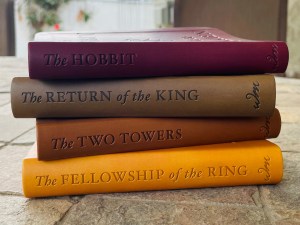
I have watched some of the movies and read excerpts. I may have even sped-read through some of The Hobbit. They say that Tolkien’s Hobbit and Lord of the Rings is fantasy for adults just as much as for children. I’d say that’s true since my students are true fans to this day! Ok, my turn. I’M IN.
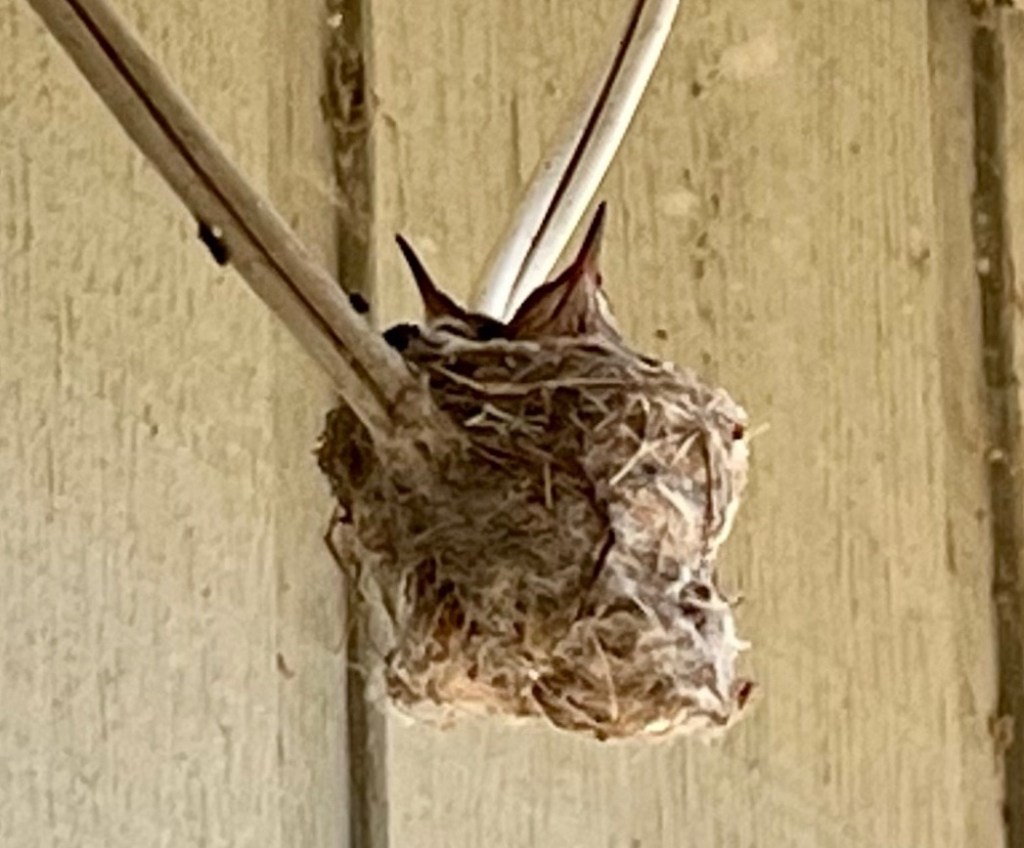
I must say that this mama did not choose the most romantic place for her nest. But maybe it’s pretty safe. Who would look for her and her babies hanging on a wire near the front porch?
Regardless of her choice, her babies are growing big. And just imagine their wonder when they finally fly out of such a drab first home into a beautiful new world!
We pulled over to the side of the road once we caught sight of a bridge overlooking a thickly wooded ravine. The sturdy bridge was broad and spacious enough that onlookers wandered from side to side, gazing at the beautiful scenery. The steep-sided ravine, with densely packed forage and closely arranged trees, was undoubtedly home to an array of wildlife. However, the birds were the creatures that were active and capturing attention that day.
This was just one of many stops during our adventure spanning over 500 miles in and around Yellowstone. The goal was Junior Ranger status for the kids, not an easy accomplishment, as we learned when our proud Junior Rangers received their badges. Traveling together, parents, grandparents, and children—eight in all, we piled out of the SUV, as we had often done over the last several days.
I do not remember whether this stop was spontaneous or part of the carefully planned itinerary. But I do know it was one of my most memorable, as simple as it was.
Beside me, walking along the bridge, was my oldest son, then nine years old. We were, at times, looking down at the ravine and then glancing up at the tall trees rooted in the steep incline that continued high above bridge level. Birds were chirping and swiftly flitting from tree to tree. Not to be outdone was the graceful flight of soaring birds of prey, occasionally landing in the treetops.
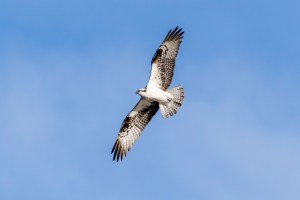
The bridge was not long, and we had barely reached the middle when my son, glancing up, exclaimed, “Hey, Mom, there’s an Osprey.”
I want to say I believed he had correctly identified the bird. At the moment, I was just happy he was trying to classify. And I would like to say I was not completely surprised when a gentleman stepped toward where we were standing, raised his binoculars, and stated, “Yep, he’s right.”
I had not seen the bird. I had failed to track much wildlife my son had pointed out during his short life. I believed he thought he saw it, and I felt sometimes he did see it. I was simply pleased that he was looking and not worried quite so much about accuracy at that stage. But my doubts began to change from that day forward.
I learned later my son had seen the Osprey in flight until it landed in a tree well off in the distance. The gentleman took an interest in my son and began a conversation with him, pointing out other birds as his party came over.
I moved on to my other children. After a bit, I glanced back at my son, still in conversation, when I had another surprise. One of the party had retrieved the largest scope I had ever seen for nature watching. It was nearly as tall as my son. After setting up the scope on a tripod, he was kind enough to explain the scope and allowed my son to peer through it.
On leaving, I rejoined my son, leaned over toward him, and asked incredulously, “How did you know that?”
“The Audubon books, Mom.” He stated it so matter-of-factly as if that easily answered my question. I thought that just flipping through the National Audubon Society Field Guide to Birds would not have been enough. He clearly had been studying the guide.
As we drove through the twists and turns of the forest road on our return, I reflected on a decision I fell upon more than made a few years before. I had been drawn to the idea of education through “real books,” as they are called, instead of textbooks. Full books on singular topics are written by authors passionate about their subject devoting untold hours in their pursuit. Textbooks, on the other hand, by nature, devote minimal time to a slew of various topics. Although valuable as an outline for subject matter, details are minimal.
The National Audubon Society Field Guide to Birds qualified as such a “ real book.” And at that moment, the uncertainty that I had felt about choosing a different pathway melted away, providing me with confidence that I had made a good decision to teach with a concentration on real books. And as my husband and I moved forward in taking full responsibility in educating our children, such moments of clarity were repeated many times over throughout the years.
And to this day, the Osprey holds a special place in my heart. I can envision the experience as if it was yesterday. My son’s siting and identifying of the Osprey reflected that first moment in time when it became clear to me that the difficult choice to take a road less traveled was reaping benefits.
President James A. Garfield | A Tale of Madness, Medicine, and Murder
In this new season of life, I am determined to read as the spirit moves me. In the past, I sincerely appreciated everything I read, well-chosen in educating my four favorite students, along with our many field trip endeavors. But I always knew the purpose and how it would best fit into the course of education.
I picked up Destiny of the Republic with no such purpose or foresight as I knew not what to expect. What I did know is that the end of this true story was heartbreaking. And what could be accomplished in just six months in office?
However, the value of a person extends beyond what they accomplished or how and when they died. The value of a person rests in how they lived. So I chose to read about this little-known President. Who was the man, and how did he live?
Legacy of a Man
With only a few months in office, James Garfield’s legacy certainly was not made in his position as President of the United States. As it should be for us all, his legacy was made in how he lived, which for him started in the home. Here is a flavor.
“With his daughter and four sons gathered around his feet, he read for hours without rest, eager to introduce them to his favorite works, from Shakespeare plays to The Arabian Knights to Audubon’s detailed descriptions of the woodchuck, the brown pelican, and the ferruginous thrush.“
In His Own Words
Some of his statements shed much light on Garfield’s depth of spirit.
I would rather be beaten in RIGHT than succeed in WRONG.
This is our only revenge…the immortal principles of truth and justice…shall stand equal before the law.
The Destiny of the republic is to be decreed…by…firesides, where thoughtful voters…with the calm thoughts inspired by love and home and country, with the history of the past, the hopes of the future, the reverence for great men who have adorned and blessed our nation in days gone by, burning in their hearts—there God prepares the verdict which will determine the wisdom of our work tonight.
You were not made free merely to be allowed to vote, but in order to enjoy an equality of opportunity in the race of life…Permit no man to praise you because you are black, nor wrong you because you are black. Let it be known that you are ready and willing to work out your own material salvation by your own energy, your own worth, your own labor.
Light itself is a great corrector. A thousand wrongs and abuses that are grown in the darkness disappear like owls and bats before the light of day.
There is no horizontal stratification of society like the rocks in the earth, that hold one class down below forevermore, and let another come to the surface to stay there forevermore. Our Stratification is like the ocean, where every individual drop is free to move, and where from the sternest depths of the mighty deep any drop may come up to glitter on the highest wave that rolls.
Reflections
In Destiny of the Republic, I learned historical facts of President Garfield’s life as much as I learned about his inadequate medical care he received after he had been shot. As an interesting sidebar, were the efforts of a young Alexander Graham Bell to invent a machine to help in the President’s care that ultimately helped the care of others.
I found it all very interesting. Previously, I had never considered or even knew about the story of the life of James A. Garfield. Candace Millard has introduced me to someone I want to know better.
Having learned the structure of Garfield’s life and some of its details, I hope to learn more about the inner man. He was known as the Preacher President. I would like to know more about that. There is also the book Civil War Letters of James A. Garfield, which sounds intriguing. Some of the best sources to determine the inner person, of course, can be found in their own words.
I am left with these thoughts of President Garfield—a family man, a spiritual man, though not perfect—gregarious living life to the fullest—a self-learner, driven and determined in his pursuits, intelligent, from a “rags to riches” life, and interestingly, he was thought to have begun the healing of a divided nation post-civil war—being seen as a president of both the North and South.
His legacy to his family may have remained hidden in their hearts. But his legacy to his nation may have been in a coming together of the North and South as one nation once again. The nation as a whole saw him as their president; they were horrified when he was shot, anxious for weeks for his recovery, and grieved his ultimate death. And they did so together as one nation and one people.

 kaffeeklatsch | coffee & conversation